|
Module 4 of Conquering Chemistry Preliminary Course 4th edition deviates from the HSC syllabus in a few minor ways in that it includes:
While it may seem surprising that the enhanced greenhouse effect (global warming) was omitted from this syllabus, it needs to be remembered that until quite recently most of our politicians in the three major parties were pretending that it did not exist and maybe it is not surprising that our syllabus writers went along with that view. However now with even the most conservative politicians conceding that global warming is happening, perhaps HSC students need some information about it. There is a short introduction in CCPC Section 10.9 with a more extensive treatment later in this website. As usual, you can use the Module 4 and the New South Wales HSC syllabus tables on pages 306–9 to check the extent to which Conquering Chemistry covers the syllabus and how closely it follows syllabus order. 1. The third allotrope of carbon, buckminsterfullerene This chemical oddity is currently attracting a
lot of textbook attention, probably as chemists try to show that new and
exciting ‘breakthroughs’ are occurring in what is really a very mature
science. Use a soccer ball to demonstrate the structure of this allotrope. A
useful web site for help on making a model is www.seed.slb.com.
Click 'Welcome' then type 'buckyball' into the search box (beside Seedlink near
the top right of the page) click on the magnifying glass then on the next screen
click on 'Build a buckyball' . Note that the syllabus requires students to name only
straight-chain alkanes and alkenes and only up to C8 (not
the C10 of the old syllabus). This means that
isomerism is involved only for alkenes and only for
position of the double bond. The syllabus does not actually mention enthalpy or enthalpy change for a reaction: however it does use DH in Section 8.4.5 without stating what it stands for (see Item 6 under Some teaching points in the web page for Module 3; click on it to go there and use the BACK button on your browser to get back here). Nevertheless CC introduces enthalpy change, DH, because it is a very basic chemical concept and because it would be awkward to discuss energy profiles (required by the syllabus) without it. Note that DH and heat of reaction are not synonymous. Heat of reaction equals DH only if the experiment is performed at constant pressure. In school laboratories most experiments are performed at constant pressure (open to the atmosphere) and so the measured heat of reaction is equal to DH. For experiments in bomb calorimeters for example (closed vessels, constant volume, but not constant pressure) the measured heat of reaction is not DH. Since 2002
experimental measurement of heat of reaction and hence of enthalpy change has not been required in the
Preliminary Course. However it is required in Module 1 of the HSC Course, and
because it is always a good idea to show how a physical quantity is measured
when the physical quantity is being introduced, the simplest method of measuring
a heat of reaction has been included in CCPC. This will serve students in good
stead when they come to measure heat of combustion of alkanols in HSC Module 1. It might be helpful (for teachers) to recall why we have enthalpy H
as well as energy E. When we heat an object or sample of a substance, not
only do we increase its energy content, but also we may inadvertently make it do
some mechanical work – by expanding against its surroundings (PDV work). Hence we
introduce a term enthalpy defined as CCPC (p 224–5) uses DHsoln
for heat of solution without explaining why the symbol H is used and
without mentioning enthalpy there. (Strictly it should be heat of solution at
constant pressure, because DH is the accepted symbol for enthalpy change and it will be
equal to the heat absorbed or released only at constant pressure.)
CCPC introduces enthalpy change on pages 276–7. Sometimes chemists are a bit lax
and omit molar when it should be put in; for example we often say heat of
combustion or heat capacity when we really mean molar heat of combustion or
molar heat capacity (quantities per mole). Ambiguity is easily avoided by
looking at the units of the quantity; if the units include mol–1
then it is a molar quantity. A heat of combustion of 2220 kJ mol–1
is clearly a molar heat of combustion; similarly a heat capacity of 72 J K–1
mol–1 is a molar heat capacity whereas a heat capacity of 143 J K–1
is the heat capacity of the whole object or total amount of substance under
consideration. Specific heat capacity (i.e. per gram, units J K–1
g–1, Table 8.2 page 223) should
never be abbreviated to 'heat capacity' (though it is sometimes abbreviated to
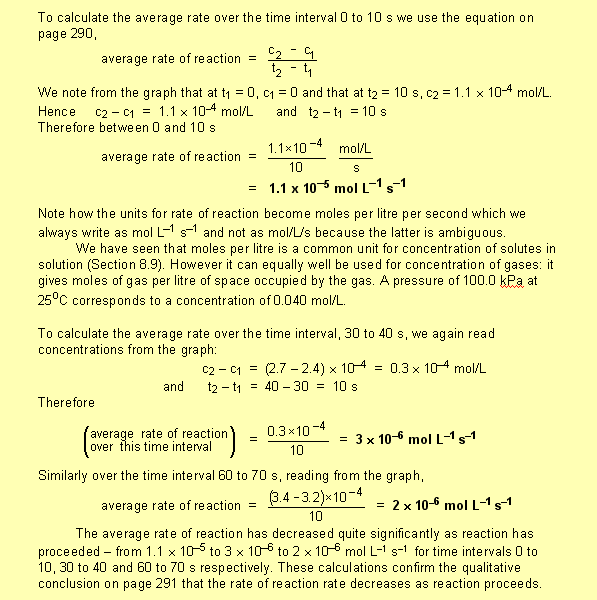
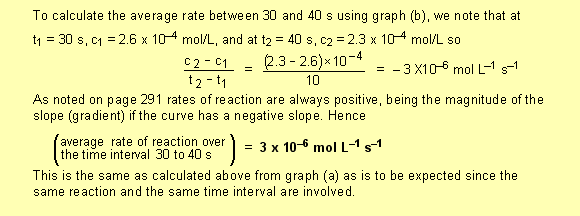
'specific heat'). 1. Meaning of rate of reaction The average rate of reaction over a small interval of time is defined on page 290. Although the HSC exam will probably ask only qualitative questions about reaction rates (such as deciding which of two graphs of concentration versus time has the greater rate), a quantitative calculation of a reaction rate may help understanding of the concept. Hence the following example.
Exercises L1 and L4 below involve quantitative
calculation of rates of reaction along the lines described here. Catalysts are involved in three important aspects of the refining and use of oil products:
(i) Balancing supply to demand
The column in which this occurs is called a cat cracker (catalytic cracker). Hydrocarbons, with 15 to 20 carbon atoms per molecule, are broken into ones with 6 to 8 carbon atoms; for example:
Cracking of a large alkane molecule produces a smaller alkane molecule and an alkene molecule. Catalytic cracking is discussed on page 6 of CCHSC 4th edition. (ii) Improving the quality of
gasoline (petrol) The performance of petrol in motor cars is measured by its octane rating. The octane rating of petrol obtained by straight distillation or catalytic cracking is too low for most car engines. Originally octane rating was improved by adding a compound called tetraethyl lead, (C2H5)4Pb. Two problems with this are first emitting lead to the atmosphere through the exhaust of motor cars is undesirable because lead is a poison and secondly lead ‘poisons’ the catalysts used to remove other pollutants from car exhausts (next sub-section). An alternative approach to using lead to boost octane rating is catalytic reforming. This is a process in which straight-chain alkanes are converted into branched-chain alkanes or into aromatic compounds (Figure 9.8 on page 258). The catalyst used is metallic platinum. An example of catalytic reforming is the conversion of heptane to toluene:
By using catalytic reforming it is possible to produce petrol with a sufficiently high octane rating without adding any lead compound, though this so-called unleaded petrol is more expensive to produce than lead-containing petrol of the same octane rating. Petrol containing lead is no longer available in NSW. (iii)
Minimising pollution from automobiles (catalytic exhausts)
In Australia today, as in most developed countries, there are legal restrictions on the amount of these pollutants that cars are allowed emit. Most car makers meet these restrictions by fitting catalytic converters into the exhaust pipes of their cars. A typical one is shown in Figure 10.7 on page 297. It consists of a ceramic honeycomb block about 30 cm long with a cross-sectional area of about 50 to 100 cm2 inside a metal canister that looks like an extra muffler in the exhaust pipe. The hexagonal or square holes pass right through the block. A thin layer of a mixture of platinum and rhodium metals which are the actual catalysts is deposited on all surfaces of the block. The aims are (1) to provide a large surface area of metal while using the smallest possible mass of these very expensive metals, and (2) to allow all the exhaust gas to come into contact with the catalytic metal film while providing only minimum resistance to flow through the catalyst. The structure has to be sufficiently robust to last at least 80000 km. The platinum catalyses the conversion of carbon monoxide to carbon dioxide and of unburnt hydrocarbons to carbon dioxide and water, while the rhodium catalyses the reaction of NO with CO to form N2 and CO2:
The formation of photochemical smog and the operation of catalytic converters are discussed further in CCHSC, pages 239–41.
|